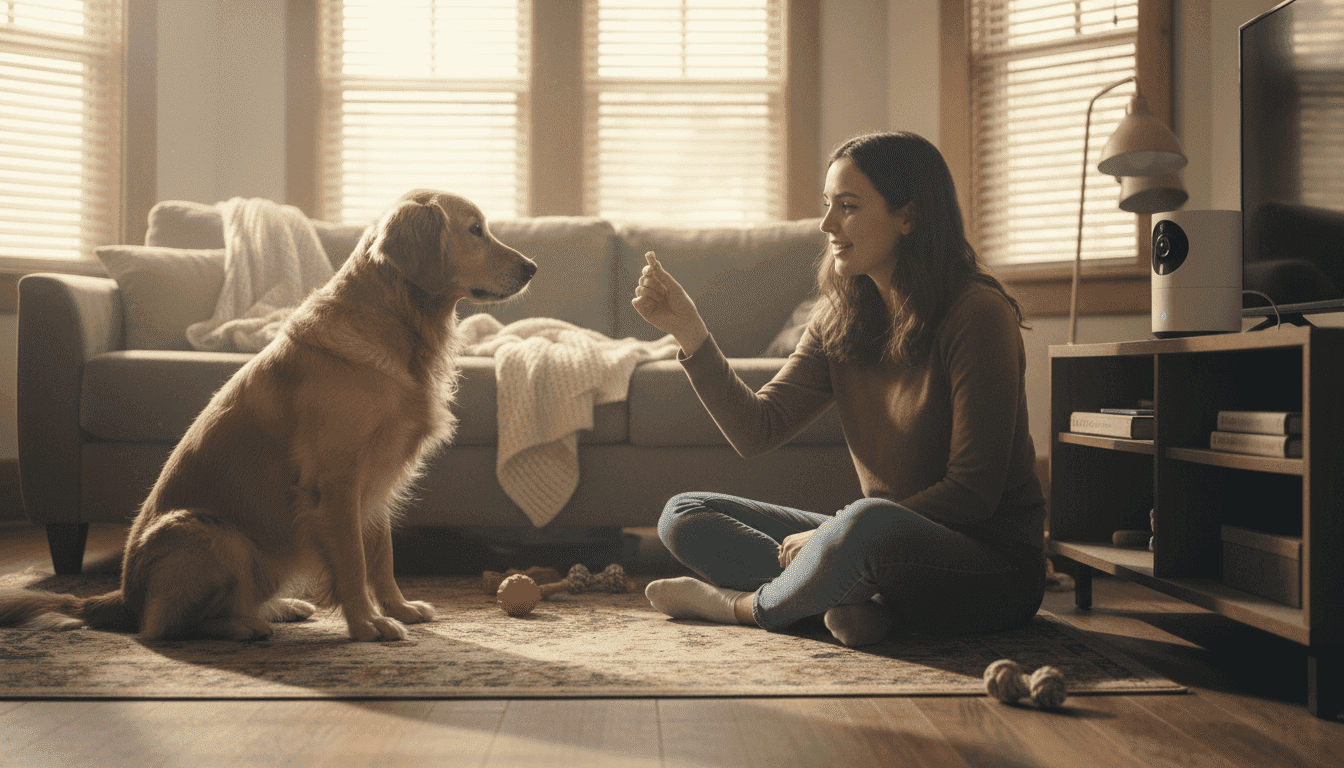
Every tech-savvy American dog owner knows the challenges of staying connected with their pet while at work or out for the day. The rise of dog training cameras now gives you new ways to spot behavior issues early and support your dog’s well-being even from a distance. By blending real-time video, two-way audio, and positive reinforcement techniques, these tools offer practical solutions for reducing separation anxiety and building better communication.
Table of Contents
- Dog Training Cameras: Core Concepts and Myths
- Types of Pet Cameras and Key Features
- How Cameras Enhance Dog Training Results
- Reducing Anxiety and Strengthening Bond Remotely
- Pitfalls, Costs, and Safety Concerns
Key Takeaways
| Point | Details |
|---|---|
| Function of Dog Training Cameras | These devices allow for real-time monitoring and remote interaction, but they do not replace hands-on training. Your active involvement is crucial for training success. |
| Common Misconceptions | Training cameras are not autonomous trainers; they supplement existing training methods and do not automatically resolve behavioral issues. |
| Selecting the Right Camera | Choose a camera based on your specific training needs, considering features like two-way audio and motion detection for effective monitoring. |
| Understanding Limitations | Camera usage should be part of a broader training strategy and not solely relied upon for correcting behaviors, as they can create dependency if misused. |
Dog Training Cameras: Core Concepts and Myths
Dog training cameras represent a shift in how modern pet owners approach behavior modification and monitoring. These devices let you observe your dog’s behavior in real time and intervene remotely, which changes the training dynamic significantly.
Understanding what these cameras actually do—versus what they can’t do—helps you set realistic expectations for training success.
What Dog Training Cameras Actually Do
Pet cameras serve specific functions in training workflows. They provide live video monitoring so you can observe unwanted behaviors as they happen, not just hear about them from your family.
Key capabilities include:
- Real-time observation of problem behaviors like excessive barking or counter surfing
- Two-way audio to deliver commands or corrections while you’re away
- Motion detection alerts that notify you when your dog moves into restricted areas
- Recorded footage to review patterns and track progress over weeks
- Remote treat dispensing to reward good behavior immediately from anywhere
The cameras don’t train your dog directly—you do. The technology simply extends your supervision when you’re not physically present.
Pet cameras are monitoring and communication tools, not autonomous trainers. Your involvement and consistency determine success.
Common Myths About Training Cameras
Myth 1: Cameras replace hands-on training. Reality: They supplement in-person work. Positive reinforcement remains the foundation of effective training, and cameras help you apply it more consistently.
Myth 2: Dogs understand you’re watching through the camera. Reality: Dogs don’t grasp that you’re remote-controlling your voice. The audio matters; the camera doesn’t change how your dog processes commands.
Myth 3: Cameras instantly reduce separation anxiety. Reality: They help manage it when combined with gradual desensitization training. Cameras alone won’t fix the underlying anxiety—they provide data to adjust your approach.
Myth 4: You can train complicated behaviors remotely. Reality: Complex commands require hands-on practice. Cameras work for reinforcing basics and catching mistakes, not teaching new skills from scratch.
Accurate information shapes smarter training decisions. Research-backed methods work better than assumptions.
How Cameras Fit Into Your Training Plan
Effective training depends on clear communication and consistency, whether you’re in the room or using remote tools. Cameras help you maintain consistency by letting you reward desired behaviors immediately, even when away.
They work best for:
- Monitoring progress on behaviors you’ve already started training
- Catching problem behaviors to address specifically
- Testing if your dog generalizes training to new environments
- Building real-world data about when and why problems occur
- Adjusting training methods based on what you observe
Cameras provide visibility; your training plan provides direction.
Pro tip: Set a specific training goal before using your camera—like reducing barking during the 2 p.m. hour—so you track meaningful progress instead of just passively watching footage.
Types of Pet Cameras and Key Features
Pet cameras come in different configurations, each designed for specific training and monitoring needs. Choosing the right type depends on your home layout, your dog’s behavior patterns, and what you want to observe.
Understanding the options helps you match technology to your actual training goals.
Camera Types for Dog Training
Basic stationary cameras mount in one location and provide fixed-angle monitoring. These work well for watching a specific room or crate area where problem behaviors occur.
Pan-and-tilt cameras rotate to follow your dog around a room. This flexibility lets you track movement and observe behavior from multiple angles without repositioning equipment.
Wireless and battery-powered options offer flexibility in placement. Unlike wired cameras, they don’t require electrical outlets, making them useful for renters or temporary monitoring setups.
Motion detection capabilities alert you when your dog enters off-limit zones. This feature helps catch unwanted behaviors like jumping on furniture or accessing the kitchen without permission.
Here’s a quick comparison of common pet camera types for home training use:
| Camera Type | Best Use Case | Mobility/Flexibility | Typical Price Range |
|---|---|---|---|
| Fixed Stationary | Monitoring single room/crate | Low—mount in one spot | $50-$100 |
| Pan-and-Tilt | Tracking dog across open space | High—rotates remotely | $100-$200 |
| Wireless/Battery | Temporary setups/rental homes | Very high—no wiring needed | $80-$180 |
| Motion Detection | Alerting for restricted zones | Medium—depends on layout | $90-$160 |
The best camera type matches your dog’s training needs, not just features. A fixed camera watching a crate zone works better than a fancy pan-tilt if that’s where problems happen.
Essential Features for Training Success
Video quality matters because you need to see what your dog actually does. Clear footage prevents misinterpretation of behavior and helps you train accurately.
Key features to prioritize:
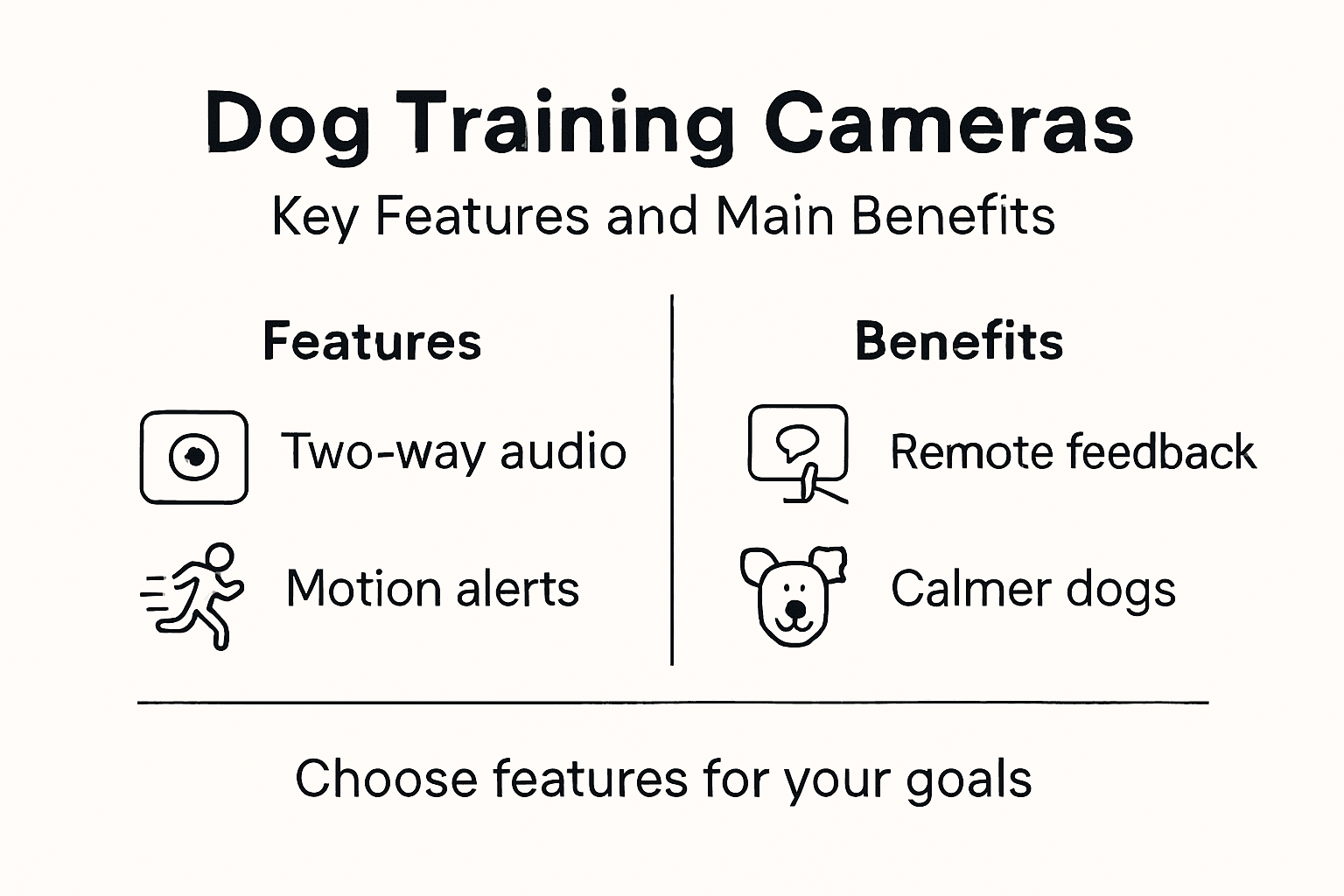
- Two-way audio for delivering commands and corrections from anywhere
- Night vision to monitor nighttime behaviors like excessive barking
- Cloud or local recording to review patterns and track progress over time
- Mobile app integration for real-time alerts and remote viewing
- Treat dispensing to reward good behavior when you’re away
- 1080p or higher resolution for seeing details like ear position and body tension
Two-way audio directly supports training by letting you reinforce behavior instantly. Without it, you’re just watching passively.
To help prioritize features, here’s a summary table linking camera features to training goals:
| Feature | Training Goal | Impact on Training |
|---|---|---|
| Two-way Audio | Remote reinforcement | Enables real-time correction |
| Night Vision | Address nighttime behaviors | Allows after-dark monitoring |
| Cloud Recording | Track progress over weeks | Supports review and analysis |
| Treat Dispenser | Rewarding calm or good behavior | Reinforces positive actions |
Selecting Features That Support Your Training Plan
Not every feature matters for every training goal. If you’re addressing separation anxiety, motion detection and two-way audio matter more than treat dispensing.
For multiple-dog households, wearable sensor systems that track individual movement patterns help you identify which dog triggered problem behavior.
Consider your specific situation:
- What behavior are you targeting (barking, destructive behavior, jumping)?
- When does it happen (mornings, evenings, random times)?
- What intervention will you use (commands, redirection, positive reinforcement)?
- Do you need to see details or just movement?
Matching features to your training goal prevents wasting money on unnecessary capabilities.
Pro tip: Start with a single-location fixed camera focused on where problem behaviors actually occur, then expand to additional cameras only if you identify new behavioral hotspots.
How Cameras Enhance Dog Training Results
Cameras transform training from a reactive process to a data-driven one. Instead of guessing why your dog misbehaves, you observe patterns, identify triggers, and adjust your approach based on what actually happens.
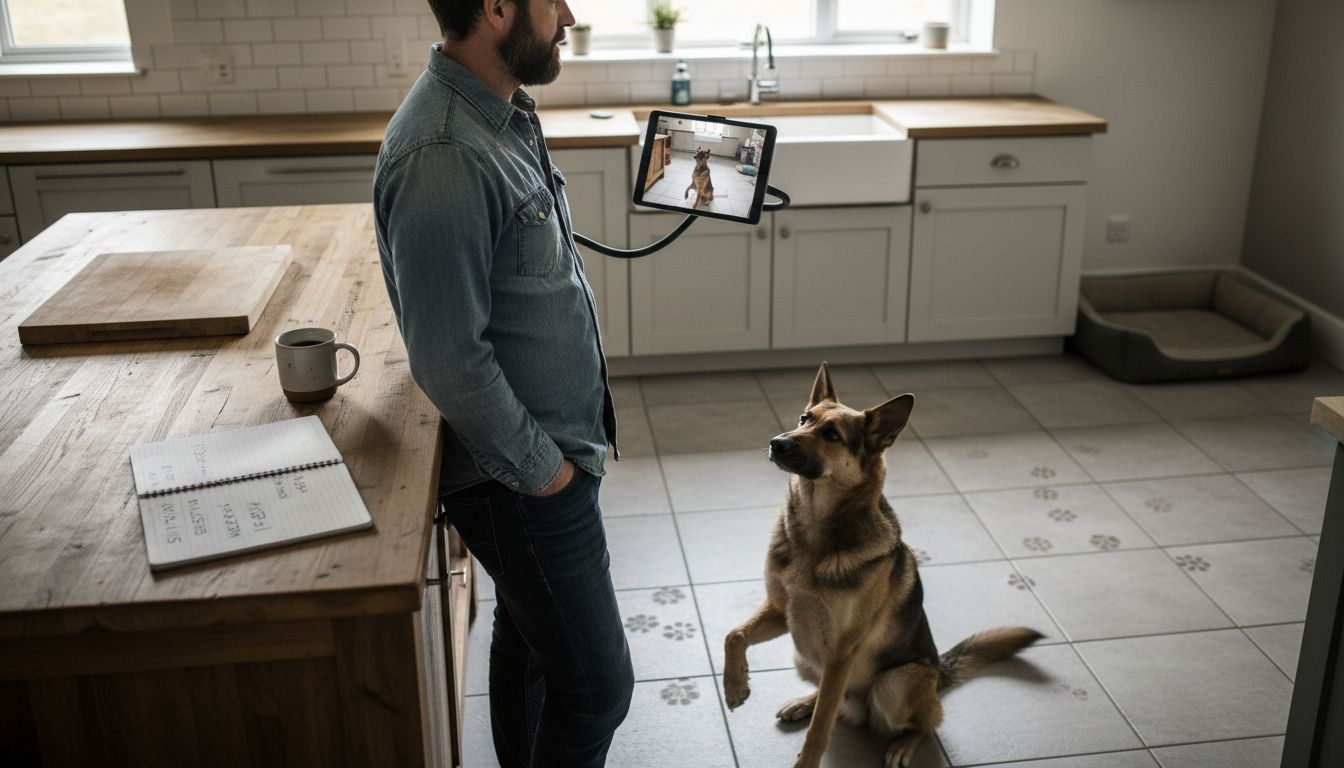
This shift moves you from hoping for improvement to tracking measurable progress.
Observe Behavior Objectively
Watching your dog through a camera removes emotional filters. You see the actual sequence of events leading to problem behavior, not just the final problem.
Many owners miss critical details. Your dog might bark because a car passed by, not because of separation anxiety. A camera reveals this distinction instantly.
Live observation lets you catch behaviors happening right now. You can intervene with two-way audio before the behavior escalates, teaching your dog the correct response in real time.
Recorded footage shows patterns over days and weeks. You’ll notice that destructive behavior happens between 2 p.m. and 3 p.m. only, or that barking spikes when a specific neighbor arrives home.
Objective observation through video reveals the true triggers of problem behavior, transforming guesswork into informed training decisions.
Review Sessions for Training Accuracy
Video reviews help trainers and owners analyze subtle behaviors that happen too fast to catch in real time. Ear position, body tension, and response timing matter—details you might miss during the moment.
Accurate observation prevents training mistakes:
- Reward the wrong behavior by accident
- Delay rewards too long after correct behavior
- Miss signs your dog understands the command
- Misread fear responses as stubbornness
Slowing down footage lets you evaluate your timing and technique, not just your dog’s response.
Identify Patterns and Track Progress
Consistent monitoring over time reveals what actually works. If barking decreased by 40% over four weeks, your current method is working—even if progress feels slow day-to-day.
Patterns show you:
- Which behaviors improved fastest
- When problem behaviors still occur
- Whether your dog generalizes training to new situations
- How your dog responds to different commands
- Progress benchmarks to celebrate
Without recorded data, you rely on memory, which is unreliable. Cameras provide objective proof that your training is working.
Measure Behavior Change Quantitatively
Advanced sensor and AI technologies can track movement patterns and physiological responses during training. While basic cameras provide video, modern smart cameras with motion analytics give you concrete numbers.
Quantitative data answers questions video alone cannot:
- Did your dog’s activity level change after medication?
- Is separation anxiety improving based on movement frequency?
- How much time does your dog spend in calm states versus anxious states?
Numbers drive better training decisions than impressions.
Pro tip: Create a simple tracking sheet marking calm versus anxious behavior observed in daily footage—five minutes per day of review gives you monthly progress data that shows whether your training strategy needs adjustment.
Reducing Anxiety and Strengthening Bond Remotely
Separation anxiety in dogs stems from uncertainty and loss of connection. Pet cameras bridge that gap by letting you maintain contact even when you’re physically away, reducing your dog’s stress and deepening your relationship through consistent interaction.
Remote connection works because your dog hears your voice, knows you’re aware of their state, and receives comfort on demand.
Understanding Dog Anxiety Through Remote Monitoring
Dogs with separation anxiety show predictable stress signals: pacing, whining, destructive behavior, or excessive barking within minutes of your departure. A camera lets you observe these patterns objectively before anxiety spirals.
Understanding neurobiological responses to stress helps you recognize early anxiety signs and intervene before they escalate. Your dog’s body language changes before behavior becomes problematic.
Early intervention prevents learned anxiety behaviors. If your dog learns that pacing leads to destruction, and destruction leads to attention, the anxiety deepens. Catching it early through remote monitoring stops that cycle.
Remote observation reveals when anxiety begins, not just when it becomes visible as destructive behavior.
Using Two-Way Audio to Provide Comfort
Your voice through a camera provides immediate reassurance. Dogs recognize their owner’s tone and respond to familiar sounds, which triggers calming neurochemical responses.
Effective remote comfort includes:
- Speaking calmly to lower your dog’s arousal level
- Using trained commands to redirect anxious behavior
- Rewarding calm behavior with praise or treat dispensing
- Maintaining consistent interaction patterns during departure
- Playing calming audio before you leave
Consistency matters most. Your dog learns that your voice means safety, not punishment.
Building Trust Through Remote Interaction
Interactions providing visual and auditory comfort during separation strengthen emotional bonds by proving you’re still connected. Your dog doesn’t experience your absence as abandonment—they experience it as a temporary change while connection remains.
This shifts your dog’s mental state from “owner is gone forever” to “owner is somewhere and checking in.”
Regular remote interaction teaches your dog:
- Departures are temporary, not permanent
- You return consistently
- Calm behavior gets your attention
- Being alone doesn’t equal being abandoned
- Your voice means everything is safe
Creating Predictable Comfort Routines
Dogs thrive on predictability. If you check in through your camera at the same times daily, your dog learns when to expect reassurance. This reduces anxiety by eliminating uncertainty.
Establish a routine where you speak to your dog at 10 a.m., noon, and 3 p.m. Your dog will remain calmer during other hours because they know those check-ins are coming.
Predictable patterns replace anxious waiting with anticipated comfort.
Pro tip: Start with short departures (15-30 minutes) while using your camera to provide reassurance every 5-10 minutes, then gradually extend time between check-ins as your dog’s confidence grows.
Pitfalls, Costs, and Safety Concerns
Pet cameras offer real benefits, but they come with genuine drawbacks. Understanding the costs, privacy risks, and potential downsides helps you make an informed decision rather than discovering problems after purchase.
Not every solution works for every situation—and cameras aren’t a cure-all for training problems.
The Real Financial Investment
Entry-level pet cameras cost $50 to $150, but that’s just the beginning. Monthly cloud storage subscriptions add $5 to $15 per device for footage backup and analysis features.
Setup and maintenance expenses include:
- Initial equipment purchase
- Installation supplies (mounts, cables, WiFi extenders)
- Monthly or annual cloud storage subscriptions
- Potential replacement of devices after 2-3 years
- Internet bandwidth costs if using high-definition streaming
A single camera with cloud storage costs $100-$200 annually. Multiple cameras for different rooms multiply that expense significantly.
Technology costs compound over time. Budget for the full three-year ownership cost, not just the initial purchase price.
Privacy and Data Security Risks
Ensuring data security and managing camera placement requires attention to privacy concerns. Pet cameras connect to your home WiFi and transmit footage to cloud servers, creating potential security vulnerabilities.
Data security considerations include:
- Unauthorized access to your home camera feed
- Data breaches exposing footage of your home and routines
- Third-party companies storing your video indefinitely
- Lack of encryption on some budget camera models
- Terms of service allowing footage use for AI training
Research your camera brand’s privacy policies before purchasing. Some companies sell anonymized behavior data to third parties.
Over-Reliance on Technology
Cameras monitor behavior but don’t replace hands-on training. Owners sometimes assume cameras handle training while avoiding the consistent, in-person work that actually solves problems.
This false reliance creates stalled progress. Your dog needs real interaction, not just remote observation. Cameras supplement training—they don’t replace it.
Camera benefits only appear when combined with active training effort.
Stress from Constant Monitoring
Implementing camera technologies requires consideration of how cameras affect the animal. Some dogs become stressed knowing they’re being watched, or they depend on your voice through the camera instead of developing independence.
Potential stress factors:
- Your dog learns to expect two-way audio intervention
- Remote correction through audio creates confusion
- Constant monitoring prevents your dog from learning autonomous calm behavior
- Treats dispensed remotely train your dog to perform for cameras, not for real-world situations
Use cameras to observe, not to manage every moment.
Installation and Technical Challenges
Pet cameras require stable WiFi, proper placement, and regular updates. Poor WiFi leads to dropped connections, making the camera unreliable when you need it most.
Wireless dead zones in your home may prevent camera placement where you need visibility. Troubleshooting connection issues takes time and technical knowledge.
Pro tip: Test your WiFi signal strength in your intended camera location before purchasing, and choose a camera with a frequency band that matches your router to avoid connectivity problems.
Unlock Dog Training Success with the Right Pet Camera
Training your dog remotely can feel overwhelming without the right tools. This article highlights the challenge of staying involved and consistent while managing behaviors like barking or separation anxiety from afar. Features such as two-way audio, motion detection, and treat dispensing can make remote training effective by letting you observe, communicate, and reward your dog in real time.
At ModernPetTech, we understand these challenges and provide detailed reviews and comparisons to help you choose the perfect device that matches your training goals. Explore our Pet Cameras section to find cameras with high video quality and smart alerts that let you monitor behaviors objectively. For step-by-step advice and product breakdowns that maximize training benefits, visit our Guides & Comparisons page.

Take control of your dog’s training progress now by discovering smart camera options tailored to your needs. Visit ModernPetTech and start turning your remote observations into measurable results that build confidence and strengthen your bond.
Frequently Asked Questions
What are the main benefits of using dog training cameras?
Using dog training cameras allows for real-time observation of your dog’s behavior, facilitates immediate intervention through two-way audio, and helps track progress over time with recorded footage.
Can dog training cameras replace in-person training?
No, dog training cameras do not replace hands-on training. They are designed to supplement in-person training by enabling consistent monitoring and reinforcement when you’re not physically present.
How do I choose the right type of dog training camera?
Consider the layout of your home, your dog’s behavior patterns, and what specific behaviors you want to monitor. Basic stationary cameras work for fixed areas, while pan-and-tilt models provide more flexibility for monitoring multiple angles.
What features should I look for in a dog training camera?
Key features to prioritize include two-way audio for real-time commands, night vision for monitoring at all times, clear video quality for accurate observation, and treat dispensing capabilities to reward good behavior while you’re away.
Recommended
- 7 Key Features in a Pet Camera Checklist for Dog Parents
- 7 Key Pet Camera Integration Benefits for Pet Owners
- What Is a Wide-Angle Pet Camera and Why It Matters
- 7 Essential Dog Monitoring Tools List for Smart Pet Owners
